
Risk Management Organization
- The Board of Directors serves as Faraday’s highest-level strategic decision-makers for risk management. It is in charge of defining risk management policies and frameworks, fostering a risk-aware culture. The board maintains ultimate accountability for overall risk management.
- The members of the Sustainability Committee include independent directors, who are appointed by a resolution of the board of directors. All members have professional knowledge and capabilities in corporate sustainability. Meetings shall be held at least once a year and may be held at any time as necessary. Its core responsibilities include promoting and strengthening sustainable development strategies, tracking and reviewing the implementation of goals, reviewing sustainability reports and supervising sustainability-related work. At the same time, the committee supervises all major issues related to sustainable development and establishes a sound risk management mechanism to effectively identify, evaluate and respond to potential risks to ensure the company's stability and resilience.
- The Risk Management Committee collaborates with operating units to implement the enterprise risk management framework to ensure that risks are thoroughly assessed and effectively controlled. It provides an annual report to the Sustainability Committee on key risks and effectiveness of controls.
- Robust systems are in place to ensure that management can swiftly assess the situation and take effective countermeasures in the event of an emergency.

Risk Management Framework and Scope
In 2020, Faraday resolved “Risk Management Best Practice Principles” as its framework for guiding risk management. These principles define the company's management objectives, organizational structure, and risk management procedures. They identify risks as four main categories of strategic risks, operational risks, financial risks, and hazard risks.
To maintain risks within acceptable limits, Faraday conducts annual risk assessments. We also develop corresponding management strategies and crisis response plans to minimize operational uncertainties.
Risk Identification
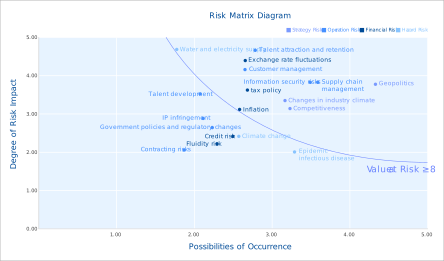
Faraday integrates various potential risks that could impact operations. Through regular risk assessments, we use of a risk matrix diagram to evaluate the frequency and impact of risk events and adopt corresponding risk management strategies based on the risk level.
Performance of Risk Management
Structure
- Governance unit: the board of directors
- Supervision unit: The Sustainability Committee (Note: Before2025.10.28 The Audit committee)
- Promotion and implementation unit: risk management committee
- Operation unit: each operating division
Scope
- Strategic risks
- Operational risks
- Financial risks
- Hazard risks
Communicating Frequency
- The Risk Management Committee is supervised and managed by the President, and the executive secretary is acted by the Chief Financial Officer.
- A cross-department risk management progress tracking meeting is held once every quarter and proposes relevant improvement suggestions.
Supervising Report
Reports the implementation status to the board of directors at least once every year. The latest implementation report on risk identification result and risk management operation had been reported to the sustainability committee and the board of directors on April 22, 2025.
Treatment
Conduct risk impact assessment and scenario analysis for each risk project. Set up and implement crisis management strategies for medium-and-high-risk impact items.
Education and training
To enhance employees' risk awareness and build a broad and deep risk management culture; internalize the risk management into daily behavior, the Company conducts regular education and training for each new recruit upon onboard day and for relevant personnel every year. Including workplace codes of conduct and professional ethics, compliance awareness and regulatory compliance, information security and privacy management, corporate social responsibility, environmental protection and sustainable practices, and occupational health and safety management.
