Faraday has imported the frameworks of TCFD (Task Force on Climate-related Financial Disclosures) and TNFD (Taskforce on Nature-related Financial Disclosures), and set up a Corporate Sustainability Committee under the Board of Directors to incorporate climate risks into corporate and financial planning.
One of the top 30 companies in Taiwan and the first ASIC design service company listed on the official TCFD supporter website
Among 320 global companies, 14 in Taiwan, and the first ASIC design service company to adopt the TNFD framework
Faraday's Net-Zero Pathway
Based on the Science-Based Targets initiative (SBTi) methodology, Faraday has established a clear carbon reduction pathway and specific targets for Scope 1 and Scope 2 emissions, demonstrating its commitment to environmental responsibility.

Overview of Faraday's TCFD Management Framework
Governance
- Highest governance body: Board of Directors
- For Faraday's climate change response and risk and opportunity management, the Board of Directors and the Corporate Sustainability Committee serve as the highest governance and oversight bodies. At the execution level, the ESG Committee drives practical project implementation and information consolidation. The Chairperson (the President) reports climate change response strategies and the progress of related projects to the Board of Directors on a quarterly basis.
- Reporting frequency: 4 times per year
- Reporting agenda: Progress on greenhouse gas inventories, formulation and review of carbon reduction strategies, and green electricity procurement plans.
- Dedicated Unit: ESG Committee
- The President serves as the chairman of Corporate Sustainability Committee, holds meeting quarterly, to lead the working group members in developing sustainability strategies and executing targets (including overseeing issues related to climate change and the company's impacts).
Strategy
- Risk & Opportunity Management and Scenario Analysis
Based on scenario analysis simulation results, the Company assesses the extent of exposure under various scenarios, analyzing how parameters such as carbon taxes and renewable energy costs impact operations. Finally, practical management measures are implemented for identified material risks and opportunities, taking into account their locations along the value chain and time horizons (short-, medium-, and long-term). - Mitigation and Adaptation
Develop feasible mitigation and adaptation measures in response to material risks and opportunities.
Risk Management
- Risk and Opportunity Identification Process
Internal and external climate-related risks and opportunities are collected and assessed based on two dimensions: likelihood and impact. Material climate risks and opportunities are then identified and prioritized accordingly. - Integration of Climate Risks
Faraday has established the “Risk Management Policy” as the highest guiding principle for internal risk management. The policy is regularly overseen and reviewed by the Company's Audit Committee and senior management. Climate change risks have been incorporated as a mandatory item in the risk identification process. Through regular risk assessment processes, the company conducts risk identification, assessment, and impact analysis. A risk matrix is used to assess the frequency of risk events and their impact on business operations, thereby defining the priority and level of each risk. Based on the risk level, corresponding risk management strategies are implemented. - Continual Improvement
The ESG Committee regularly tracks the achievement status of climate targets, while the Risk Committee consistently monitors the implementation effectiveness of climate mitigation and adaptation strategies.
Metric and Target
- Greenhouse Gas Inventory
Conduct a greenhouse gas emissions inventory in accordance with the ISO14064-1 standard, using the parent company and consolidated financial statement subsidiaries as the boundary, and perform annual third-party verification to enhance the credibility of decarbonization target implementation outcomes. - Management Target
Faraday establishes achieving net-zero emissions by 2050 as the core driving direction for climate risk response and the transition plan. Based on this, the Company implements relevant action plans and sets targets, which are incorporated into the regular tracking of implementation effectiveness conducted by the ESG Committee: - Annual carbon reduction target setting
- Annual green electricity target setting
- Supply chain carbon reduction target setting
- Energy-saving and carbon-reduction projects are implemented annually.
Risk Scenario Analysis
| Risk type | External scenario selection | External scenario description | Parameter setting and reference tool | Analysis result |
| Transition risk | National net zero pathway | Referring to the net zero pathway by 2050 plan announced by government, will meet net zero by 2050. |
|
Faraday's future carbon emissions may continuously rise due to business expansion, under the trend of increasingly strict net-zero, need to import aggressive strategy and target for carbon reduction (including carbo reduction for business operations and low-carbon product development), to reduce the material financial impact from climate risk. |
| Transition risk | SSP1-1.9 | Referring to “IPCC Sixth Assessment Report”, the allowed emissions of SSP1-1.9 will meet net zero by 2055. |
|
|
| Physical risk | SSP1-8.5 | Referring to the SSP5-8.5 scenario in “IPCC Sixth Assessment Report”, the global carbon emissions will be doubled by 2050. |
|
The location of Faraday headquarters is not directly located at the site of disaster potentials, the occurrence possibility of the flood, mudslide or landslide is extremely low. |
Identification of Risks and Opportunities, Financial Impact Analysis
Referring to the TCFD and TNFD frameworks, Faraday integrates the risk and opportunity assessment into a single workflow to ensure comprehensive consideration of environmental financial impacts. Once risks and opportunities are identified, we will conduct an overall review to establish a robust management framework and develop appropriate response measures for effectively safeguarding the corporate's long-term value.
Greenhouse Gas Inventory
Faraday adopts the operational control approach to conduct the greenhouse gas emissions inventory for Scope 1 and Scope 2 at the Hsinchu headquarters and the Taipei and Tainan offices. Scope 2 emissions were identified as the primary source, accounting for over 90% of total emissions.

Energy Management
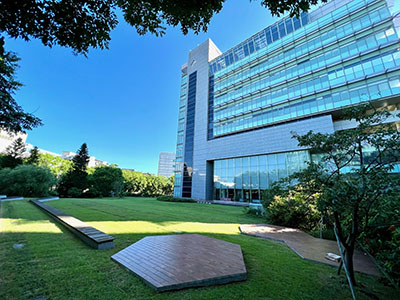
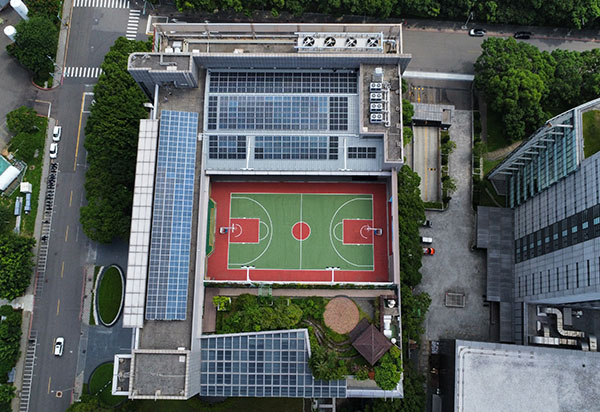
Faraday adopts a systematic mechanism to record electricity usage and identify key energy consumption hotspots regularly through power analysis tools. Annual projects are implemented to enhance energy efficiency and promote energy-saving and carbon reduction. Renewable energy is also applied to minimize environmental impacts. In 2022, the first phase of solar panel installation was completed at the Hsinchu headquarters, with the second phase scheduled for 2024.
Procurement of Externally Supplied Green Electricity
By the end of 2025, Faraday reached a total renewable energy consumption of 1.469 million kWh. With 1.32 million kWh sourced from purchased renewable energy (1,320 T-RECs), we successfully achieved a 20% renewable energy usage rate and cut carbon emissions by 696 tons.
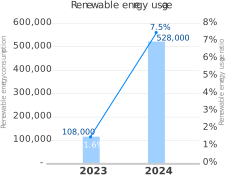
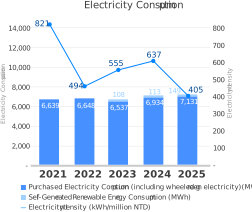
Electricity consumption analysis 2021~2024(Unit:kWh)
| Item | 2023 |
2024 |
2025 |
|---|---|---|---|
| Purchased electricity consumption | 6,536,616 | 6,934,325 | 7,130,738 |
| Renewable energy consumption | 108,000 | 113,000 | 149,288 |
| Total electricity consumption | 6,644,616 | 7,047,325 | 7,280,027 |
| Renewable energy usage ratio | 1.63% | 7.5% | 20.2% |
Energy efficiency and carbon reduction
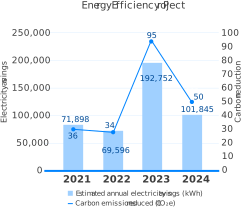
Faraday updates energy-saving equipment annually, identify energy-saving opportunities and implement specific projects according to significance and feasibility. Additionally, the concept of energy efficiency and carbon reduction is integrated into daily operations through automated energy-saving settings and awareness campaigns to ensure effectiveness.
Internal Carbon Pricing Mechanism
Faraday Technology has officially implemented an Internal Carbon Pricing (ICP) mechanism starting in 2025. The internal carbon price for 2025 has been set at NT$2,200 per metric ton, based on a comprehensive evaluation of key factors including (1) the implicit carbon reduction costs of facility equipment, (2) green power procurement premiums (environmental benefit price differentials), and (3) Taiwan’s official carbon pricing regulations. The company adopts a "Shadow Pricing" model, integrating carbon emission costs into the Benefit-Cost Ratio (B/C Ratio) evaluations for facility equipment procurement. By internalizing external costs within our management processes, we aim to refine the quality of procurement decisions and further strengthen the company’s resilience against the financial impacts of future climate change.