• Ranked in the top 5% among listed companies in corporate governance evaluation

  • Receiving an “Excellent” rating in the internal performance evaluation of the Board of Directors, functional committees, and individual board members in 2024.

  • Achieved 100% actual attendance rates for the Board of Directors, the Audit Committee, the Compensation and Remuneration Committee and the Nomination Committee in 2024.

  • Consolidated revenue in 2024 will reach NT$11.06 billion, with basic earnings per share of NT$4.04.

  • Establish a policy on linking managers' compensation and remuneration to ESG performance evaluation and Clawback Policy.

  • The proportion of female Directors increased to 33.33%, increasing female participation in company decision-making and improving the board structure.

Key Performance Indicators

Material sustainability issues Performance indicators Goals in 2024 Performance in 2024 Goals in 2025 2030/Long-term Goals
Information security
Maintaining ISO27001:2022 certificate validity Achieved Achieved Achieved Complete ISO 27001 certificate renewal audit before expiration in 2026; continuous PDCA improvement
Information security policy announcement for all the employees once per quarter 100% 100% 100% Adjust content of information security advocacy based on intelligence assessment
Implement information security training for all new recruits 100% 100% 100% Adjust content of training course according to current company instruction
No case on complaints about violation of customer privacy or loss of customer data 0 case 0 case 0 case Reassess based on the current information security architecture to ensure the protection of customer privacy and data security.
Conduct information security audit for all suppliers 100% 100% The results of the information security audit should be quantified with a score, with at least 70% of the suppliers achieving a score of 80 or above. Assess if the method of data exchange with the supplier needs to be adjusted

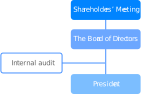
The Board of Directors of Faraday has appointed Vice President and CFO, Ms. Wen-Ju Tseng, as the Corporate Governance Officer, with the Finance Department serving as the corporate governance working group to conduct related affairs.
  • Organize for the Board of Directors and Shareholders' meetings
  • Prepare minutes for the Board of Directors and Shareholders’ meetings
  • Assist directors with their appointments and ongoing education
  • Provide directors with necessary information for business execution
  • Assist directors in complying with relevant laws and regulations.
  • Report to the Board of Directors on the qualifications review of independent directors during the nomination, selection, and term of office
  • Handle director changes
  • Other matters as stipulated by the articles of association or agreements

    The Board of Directors

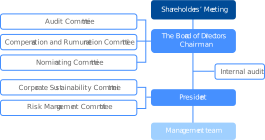
    The nomination and selection of Faraday’s Board members are conducted in accordance with the provisions of the “Articles of Incorporation” and a “candidate nomination system”. The process adheres to the “Corporate Governance Best Practice Principles” and the “Board Election Regulations”, ensuring that the overall composition of the Board maintains both professionalism and diversity. The number of Board members ranges from 7 to 11, with the exact number determined by the Board’s authorization. Directors elected at the shareholders’ meeting based on their professional expertise serve a three-year term.

    The qualifications, shareholding requirements, concurrent position restrictions, nomination, and selection process for independent director candidates comply with the “Company Act, Securities and Exchange Act”, and other relevant regulations. All directors possess the knowledge, skills, and expertise required for their duties and uphold a high level of self-discipline. To avoid conflicts of interest, directors recuse themselves from discussions and voting on matters in which they have a personal stake, in accordance with the law.

    The 12th-term Board of Directors consists of 9 members, including 3 independent directors. To promote gender equality, enhance female participation in decision-making, and optimize board structure, one additional female director was appointed in this term. The proportion of female directors thus increases to 33.33%, exceeding the original target of 25%. Moving forward, we aim to increase the number of independent directors to further strengthen the Board’s independence and supervisory functions.

    None of the directors fall under any of the disqualifications listed in “Article 30 of the Company Act”, nor do they have spousal or family relationships within second-degree of kinship, ensuring compliance with Article 26-3, Paragraphs 3 and 4 of the “Securities and Exchange Act”. All independent directors meet the independence regulations set by the Financial Supervisory Commission.

    Responsibilities of Board of Directors

    • Formulating Faraday's operational plans
    • Reviewing the annual financial reports and the second-quarter financial reports audited and certified by an accountant
    • Establishing or amending the internal control system and evaluating its effectiveness
    • Establishing or amending the procedures for handling major financial and business transactions, including
      • Acquisition or disposal of assets
      • Engagement in derivative financial transactions
      • Lending of funds
      • Providing endorsements or guarantees
      • Fundraising, issuing, or privately placing equity-type securities
    • Appointing or dismissing the Chairperson of the Board
    • Appointing or dismissing heads of financial, accounting, or internal audit
    • Approving donations to related parties or major donations to non-related parties. Emergency or relief donations due to major natural disasters may be ratified in the next board meeting.
    • Other significant matters that, according to laws, the Articles of Incorporation, or regulatory requirements, must be resolved by the shareholders' meeting or the Board of Directors.

    Document Download

    Audit Committee

    Faraday's Audit Committee is composed of all independent directors, with no fewer than 3 members. One member serves as the convener, and at least one member must have expertise in accounting or finance. Independent directors serve a term of 3 years and may be re-elected. The committee meets at least once per quarter and may convene additional meetings as needed.

    Responsibilities of Audit Committee

    • Formulating or amending the internal control system in accordance with Article 14-1 of the Securities and Exchange Act
    • Evaluating the effectiveness of the internal control system
    • Formulating or amending the procedures for handling significant financial and business activities, such as acquiring or disposing of assets, engaging in derivative transactions, lending funds to others, providing endorsements or guarantees, in accordance with Article 36-1 of the Securities and Exchange Act
    • Matters involving the interests of directors
    • Significant asset or derivative transactions
    • Significant lending of funds, endorsements, or guarantees
    • Fundraising, issuance, or private placement of equity-type securities
    • Appointment, dismissal, or remuneration of the certified public accountant
    • Appointment or dismissal of the financial, accounting, or internal audit supervisors
    • The annual financial report signed or stamped by the chairman, managers, and accounting supervisors, and the second-quarter financial report audited and certified by an accountant
    • Other significant matters as required by the company or regulatory authorities

    Document Download

    Compensation and Remuneration Committee

    Faraday's Compensation and Remuneration Committee assists the Board of Directors in implementing and evaluating the overall compensation system and executive remuneration. The committee meets at least twice a year. It consists of 3 members, appointed by a resolution of the Board of Directors, with the majority of members being independent directors. One independent director is elected as the convener and chairman to represent the committee externally. The professional qualifications and independence of the committee members should comply with Articles 5 and 6 of the Compensation and Remuneration Committee Charter.

    Responsibilities of Compensation and Remuneration Committee

    • Regularly reviewing the organization and regulations of the Compensation and Remuneration Committee and propose amendments
    • Establishing and regularly reviewing performance evaluation standards for directors and executives, as well as the annual and long-term performance goals, and the compensation policies, systems, standards, and structure. The content of performance evaluation standards should be disclosed in the annual report
    • Regularly assessing the performance goals of directors and executives, and determining the individual compensation amounts and contents based on the evaluation results.

    Performance and Compensation

    Faraday's director compensation is determined in accordance with Article 16 of the “Articles of Incorporation”, considering each director’s participation and contribution to the company operations, while also referencing industry standards. The Board of Directors determines the compensation accordingly. If the company generates a profit in a given year, up to 2% of the profit is allocated as director remuneration, as stipulated in Article 27. Additionally, director compensation is regularly assessed according to the “Board Performance Evaluation Regulations” and reviewed by the Compensation Committee and the Board of Directors to ensure performance-based assessment and fair compensation.

    For executive compensation, in addition to considering the overall operational performance, evaluations take into account:

    • Each executive’s role and contributions to the operations
    • Individual performance
    • Financial indicators
    • Sustainability indicators, including environmental, social, and corporate governance aspects
    • Future risk factors
    • Industry compensation benchmarks

    The Compensation and Remuneration Committee conducts individual assessments and submits proposals to the Board of Directors for resolution. The compensation system, standards, and structure are periodically reviewed in line with business conditions and regulatory requirements to ensure a balance between sustainable operations and risk management. If the company generates a profit in a given year, no less than 1% of the profit is allocated as employee remuneration, in accordance with Article 27 of the Articles of Incorporation.

    To enhance corporate governance effectiveness and ensure the reliability of financial results, Faraday formally established a "Clawback Policy for Executive Compensation" in 2024. The policy clearly defines the circumstances under which certain compensation can be reclaimed in the event of a significant financial restatement, safeguarding the best interests of the company and its shareholders while reinforcing long-term corporate stability.

    Document Download


    Nominating Committee

    Faraday's Nominating Committee is composed of at least 3 directors appointed by the Board of Directors, with a majority required to be independent directors. The tenure of a director serving on the committee begins upon appointment by the Board and continues until the end of their directorship term, resignation from the committee or directorship, or replacement by the Board.

    Responsibilities of the Nominating Committee

    • Establishing criteria for the expertise, skills, experience, and diversity (including gender) required for board members and executives, and conducting searches, reviews, and nominations for candidates
    • Structuring the Board of Directors and its committees, evaluating the performance of the Board, its committees, and executives, and reviewing the independence of independent directors
    • Developing and periodically reviewing training programs for directors and succession plans for executives
    • Revising the company's governance practices
    • Handling other matters assigned by the Board of Directors

    Document Download

    Internal Audit

    • The Internal Audit Department, reporting to the Board of Directors, is staffed with qualified full-time internal auditors and deputies, in accordance with the company's size, business operations, management requirements, and relevant regulations.
    • The appointment and dismissal of the chief internal audit must be approved by the Board of Directors and the Audit Committee. The appointment, dismissal, performance evaluation, and compensation of internal audit personnel are proposed by the chief internal auditor and approved by the Chairperson of the Board.
    • Internal auditors participate annually in continuing education programs offered by professional institutions to maintain their expertise. Relevant personnel information is disclosed on the Market Observation Post System for record-keeping in compliance with regulations.

    Purpose of Internal Audit

    Internal audit supports the Board of Directors and management by identifying deficiencies in the internal control system, evaluating operational efficiency, ensuring the reliability of financial reporting, and verifying compliance with regulations. It provides timely recommendations to enhance the effectiveness of internal controls, serves as a foundation for reviews and adjustments, and promotes sound corporate operations.

    Internal Audit Operations

    • Annual audit tasks are executed based on the audit plan approved by the Board of Directors, with regular follow-up on implementation and improvements. Special audits or reviews may be conducted as needed to provide management with insights into the implementation and potential weaknesses of the internal control system.
    • Internal auditors maintain independence and perform their duties objectively and impartially. They regularly report audit progress and results to the Audit Committee and attend routine meetings of the Board and the Audit Committee to present their findings.